
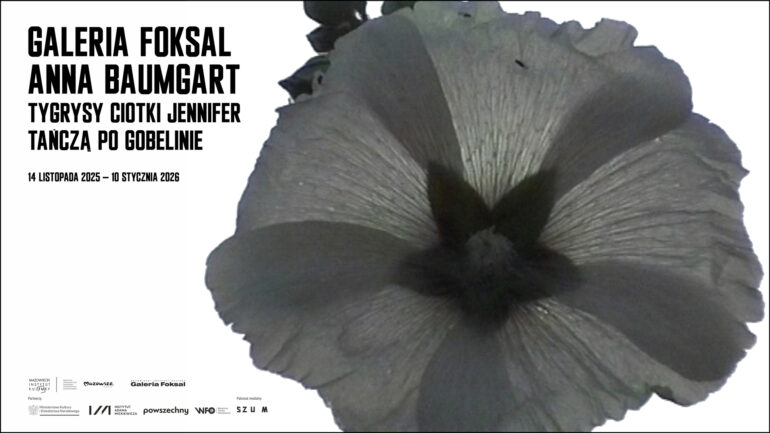
November 14, 2025
Opening: November 14th, 2025.
Exhibition runs until January 10th, 2026
curator: Katarzyna Krysiak
Music: Sebastian Dembski; Exhibition scenography: Marta Szypulska
Accessibility: a TOTUPOINT® beacon — part of a navigation and information system for blind and visually impaired people — is installed at the gate leading to the gallery.
‘The multiplicity of human and non-human forms raises questions that concern a certain community, a certain 'we’. But is this community defined solely by what is human?’ writes Anna Barcz, an eco-expert for the exhibition Aunt Jennifer's Tigers Prance Across a Screen, the main element of which will be a new visual essay.
The essay combines fragments of archival documentaries and film reels that were never made into complete films. Once inaccessible to viewers due to outdated technology, these materials gain new visibility through digitisation and a renewed intellectual interpretation framed within the language of contemporary ecoscience and the blue humanities.
The first essay – Wanda – tells the story of a group of girls who drowned in 1948 after taking their boats out onto Lake Gardno in northern Poland. The second essay draws on found footage and includes the film notebooks of Simona Kossak, a professor of forestry sciences, as well as educational films from the archives of the Educational Film Studio in Łódź. The work represents a moving archive of interspecies inclusion created through a process of recycling and recontextualisation, with an original music composed by Sebastian Dembski. The artist's early video work Winter (1997), presented here, resonates with new meanings today particularly when viewed in the context of other films. Baumgart's artworks will also be accompanied by nature documentary filmmaker Aleksandra Jaskólska's 1956 film On Water, Plants, and Slits.
Anna Baumgart seeks to capture a perspective free from speciesism, drawing on the intuitions of 20th-century female documentary filmmakers and ecosystem researchers. Hers is a perspective that encompasses not only the boundaries separating us from the non-human world, but also our very separateness. In the face of rapid climate changes and the resulting ecological catastrophes, species extinction, and migration of human and non-human bodies, attentiveness to one another becomes imperative. What does it mean to live a good life – and what does that mean for seven billion of us? This must remain an ongoing conversation, unconfined by cultural, geographical, or linguistic borders. Within this dialogue, a space opens up for art and its intersections with the third-person empiricism of science. The visual essay Aunt Jennifer's Tigers Prance Across a Screen also offers a new way of bringing to light previously unknown archival materials by outstanding female documentarians and scientists. A new life for intellectual and visual legacies hidden in home archives.
The goal is to make the subaltern speak (after Gayatri Chakravorty Spivak), that is, to imagine how to create alternative systems that communicate in different languages and form the foundation for a new logic of future coexistence. The project invites reflection on the consequences of human actions toward the non-human world and encourages greater awareness of our shared responsibility. The exhibition also marks the 30th anniversary of Anna Baumgart's artistic practice. A forthcoming publication will present the artist's work in a broader context, tracing the evolution of her ideas and visual language.
The exhibition title is taken from a 1951 poem by Adrienne Rich.
Anna Baumgart (born 1966 in Wrocław) – a post-conceptual PhD visual artist, director, and stage designer. Multiple-time grantee of the Ministry of Culture and National Heritage. Her film, performance, and sculptural works have been presented in numerous exhibitions, including at the Brooklyn Museum of Art, the Jewish Museum in New York, Neuer Berliner Kunstverein in Berlin, KW Institute for Contemporary Art in Berlin, Museum on the Seam in Jerusalem, Casino Luxembourg in Luxembourg, the CCA in Moscow, Riga, and Tallinn, as well as at the Zachęta National Gallery of Art and the Ujazdowski Castle Centre for Contemporary Art in Warsaw, the Museum of Modern Art in Warsaw, the POLIN Museum in Warsaw, the National Museum in Warsaw, and at video and documentary art festivals such as Videobrasil in São Paulo, Videonale in Bonn, Monstrainvideo in Milan, the European Media Art Festival in Osnabrück, New Horizons, and Watch Docs. Her project Sun Conquerors (2012) was invited to Manifesta 10, but due to Putin’s invasion of Ukraine, the artist declined the invitation in protest. Her film Fresh Cherries (2010) received the Audience Award for Best Video at the Loop Festival in Barcelona. Her works are included in numerous Polish and international collections, including Hauser & Wirth, FRAC Poitou-Charentes, Zachęta National Gallery of Art, the Upper Silesian Museum in Bytom, the European Parliament in Strasbourg, the National Museum in Warsaw, NOMUS New Art Museum in Gdańsk, and the Arsenal Gallery in Białystok. From 2000 to 2006, she ran the Baumgart Café at the Ujazdowski Castle Centre for Contemporary Art, an artistic-activist project that became a cult venue on Warsaw’s cultural map at the time.
Partners: Powszechny Theatre in Warsaw, Adam Mickiewicz Institute, WFO Film Studio
Media patronage: Szum Magazine
 English (UK)
  Polski